
This article is also available in Spanish.
In his latest essay titled “Black or White?” Arthur Hayes, co-founder and former CEO of cryptocurrency exchange BitMEX, presents an analysis predicting that Bitcoin could rise to $1 million. Hayes argues that upcoming U.S. economic policies in Donald Trump’s second term could set the stage for Bitcoin’s unprecedented growth.
Hayes draws parallels between the economic strategies of the United States and China, coining the term “American capitalism with Chinese characteristics.” It suggests that, similar to China’s approach under Deng Xiaoping and continued by Xi Jinping, the United States is moving toward a system in which the government’s primary goal is to maintain power, regardless of whether the policies are capitalist, socialist or fascist.
Why is the Fiat system damaged?
“Like Deng, the Pax Americana ruling elite does not care whether the economic system is capitalist, socialist or fascist, but whether the policies they implement will help them retain power,” Hayes writes. He emphasizes that in the early 20th century America ceased to be purely capitalist, noting: “Capitalism means that the affluent lose money by making bad decisions. It was banned as early as 1913 when the United States Federal Reserve was established.”
Hayes criticizes the historic shift from trickle-down economics to direct stimulus measures, especially those implemented during the Covid-19 pandemic. He distinguishes between “quantitative easing for the rich” and “quantitative easing for the poor”, highlighting how direct stimulus to the general public boosted economic growth, while quantitative easing primarily benefited wealthy asset holders.
“From the second quarter of 2020 to the first quarter of 2023, Presidents Trump and Biden bucked this trend. Their treasuries issued debt that the Fed purchased using printed dollars (QE), but instead of giving them away to the affluent [individuals]The Treasury sent checks to everyone,” he explains. This led to a decline in the US debt-to-nominal GDP ratio as the increased purchasing power of the average citizen stimulated real economic activity.
Looking ahead, Hayes predicts that Trump’s return to power will usher in a policy focused on relocating key industries to the U.S., financed by sweeping government spending and an enhance in bank lending. He refers to Scott Bassett, whom he believes Trump will choose as Treasury Secretary, noting that Bassett’s speeches outline plans to “raise nominal GDP by providing government tax credits and subsidies to once again support key industries.”
“The plan is to raise nominal GDP upwards by providing government tax breaks and subsidies to key industries (shipbuilding, semiconductor factories, car manufacturing, etc.). Companies that qualify will then receive low-cost bank financing,” Hayes states.
It warns that such a policy would lead to significant inflation and currency devaluation, which would adversely affect holders of long-term bonds or savings deposits. To protect against this, Hayes recommends investing in assets such as Bitcoin and gold. “Instead of saving on fiat bonds or bank deposits, buy gold (a hedge against baby boomer financial repression) or Bitcoin (a hedge against millennial financial repression),” he advises.
Hayes supports his thesis by analyzing the mechanisms of monetary policy and bank credit creation. It illustrates how “quantitative easing for the poor” can stimulate economic growth by increasing consumer spending, unlike “quantitative easing for the rich,” which inflates asset prices without contributing to real economic activity.
“QE for needy people stimulates economic growth. By handing out stimulus checks, the State Treasury encouraged plebeians to buy trucks. Thanks to the demand for goods, Ford was able to pay its employees and apply for loans to enhance production, he explains.
Additionally, Hayes discusses potential regulatory changes, such as exempting banks from the Supplementary Leverage Ratio (SLR), which would allow them to purchase an unlimited amount of government debt without additional capital requirements. He argues that this would pave the way for “infinite QE” aimed at productive sectors of the economy.
“If government bonds, central bank reserves and/or approved corporate debt securities were excluded from the scope of the SLR, a bank could buy an infinite amount of debt without having to burden itself with expensive capital,” he explains. “The Fed has the authority to grant a waiver. They did this from April 2020 to March 2021.”
How Bitcoin Can Reach $1 Million
Hayes believes that the combination of aggressive fiscal policy and regulatory changes will lead to an explosion in bank lending, which will lead to higher inflation and a weakened US dollar:
The combination of industrial policy legislation and the SLR exemption will result in a acute enhance in bank lending. I have already shown that the monetary velocity of such a policy is much greater than that of classic QE for affluent people overseen by the Fed. Therefore, we can expect Bitcoin and cryptocurrencies to perform as well, if not better, than from March 2020 to November 2021.
He argues that in such an environment, Bitcoin will benefit the most due to its scarcity and decentralized nature. “This is how Bitcoin reaches $1 million because prices are set on margin. As the supply of free-floating bitcoins declines, the most fiat currency in history will seek a protected haven,” he predicts. Hayes backs up this claim by referring to his custom index that tracks the supply of U.S. bank loans, showing that Bitcoin has outperformed other assets after accounting for growth in bank loans.
“What is it [..] what matters is how a given asset behaves after deflation by the supply of bank credit. Bitcoin (white), S&P 500 index (gold), and gold (green) were divided by my bank loan index. Values are indexed to 100 and as you can see, Bitcoin stands out, growing over 400% since 2020. If there is only one thing you can do to counter the degradation of fiat value, it is Bitcoin. You can’t argue with mathematics,” he says.
Concluding his essay, Hayes urges investors to adopt the appropriate posture as they await macroeconomic developments. “Be long and stay long. If you doubt my analysis of QE’s impact on needy people, just read China’s economic history over the last thirty years and you’ll understand why I call the novel economic system Pax Americana “American capitalism with Chinese characteristics,” he advises.
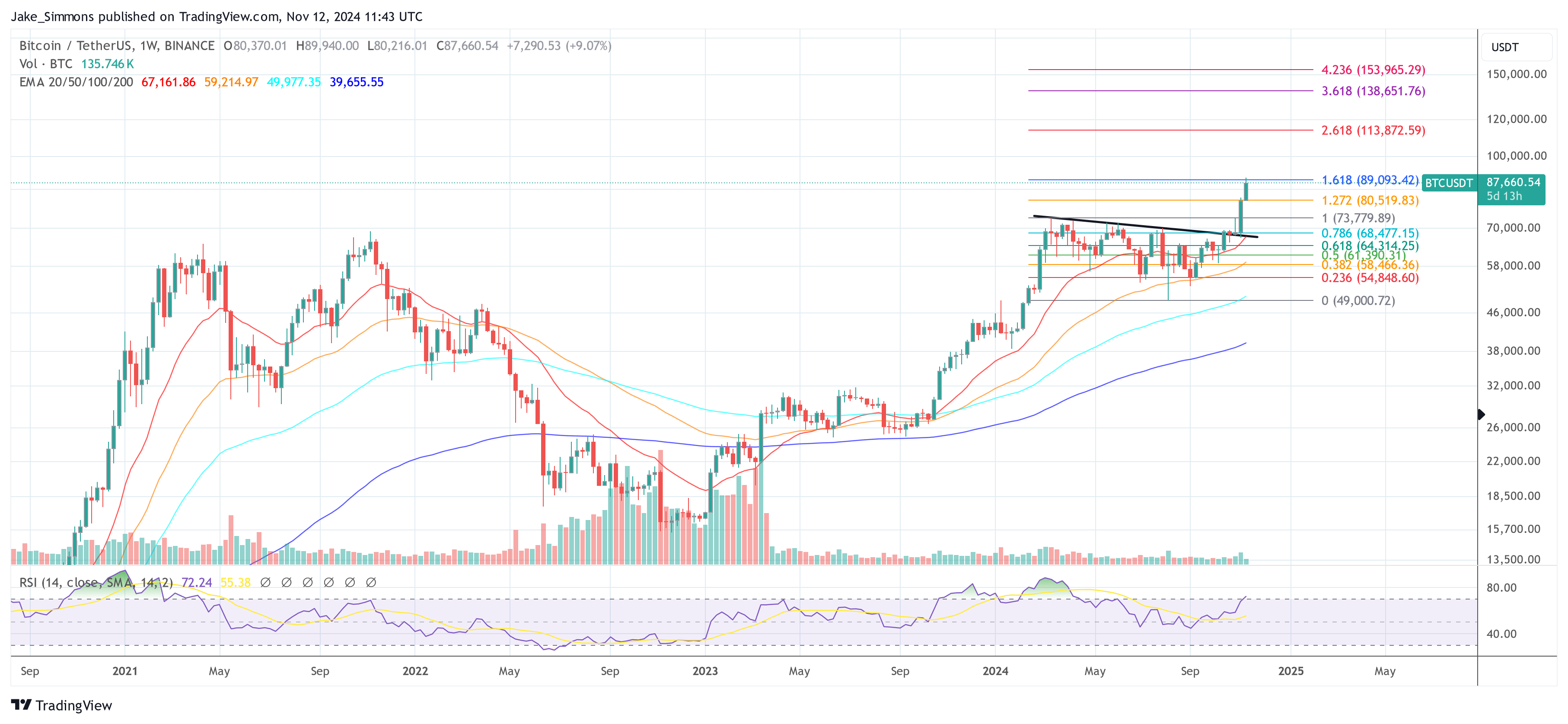
At the time of publication, the BTC price was $87,660.
Featured image from YouTube, chart from TradingView.com
